Solar Energy Research Institute

Institut Penyelidikan Tenaga Suria | Solar Energy Research Institute
LONGi’s Back-Contact Solar Technology and Malaysia’s Role in the Energy Transition
LONGi’s Back-Contact Solar Technology and Malaysia’s Role in the Energy Transition
Solar photovoltaic technology is entering a decisive decade. As countries accelerate the transition from fossil fuels to low-carbon electricity, solar PV has become one of the most scalable, bankable and rapidly deployable renewable energy technologies. The International Energy Agency projects that global renewable power capacity will increase by almost 4,600 GW between 2025 and 2030, with solar PV representing nearly 80% of worldwide renewable electricity capacity expansion. This growth directly supports the United Nations Sustainable Development Goal 7, which calls for affordable, reliable, sustainable and modern energy for all.
Within this global momentum, crystalline silicon continues to dominate the PV industry because of its proven reliability, mature manufacturing ecosystem and continuous efficiency improvement. However, as mainstream technologies such as PERC and TOPCon approach practical performance limits, the industry is searching for the next high-efficiency platform. Back-contact solar technology, particularly LONGi‘s HPBC architecture, is emerging as one of the most important pathways.
A Technology Built for the Future
Founded in 2000 in Xi’an, China, LONGi Green Energy Technology Co., Ltd. has grown from a monocrystalline silicon specialist into one of the world‘s leading integrated solar technology companies. In 2024, LONGi reported revenue of CNY 82.582 billion and invested CNY 5.014 billion in research and development, with 3,342 authorised patents, including more than 400 related to back-contact cells and modules. This level of sustained R&D investment reflects a fundamental shift in the solar industry: future competitiveness will depend less on selling the lowest-cost module and more on delivering the lowest lifetime cost of electricity. LONGI Lighthouse factories represent the epitome of intelligent manufacturing and digitization in today’s global manufacturing industry, initiated by McKinsey & Company and the World Economic Forum. LONGi’s Jiaxing production base was included in global lighthouse network in 2023, becoming the world’s first Lighthouse Factory in the PV industry. LONGi leverages digitalization and intelligent tools for a more sustainable business.
In April 2026, established new world records for crystalline silicon technology, achieving 28.13% efficiency on their HIBC solar cells and 26.4% on modules, verified by ISFH and NREL, respectively. LONGi holds the authoritative NREL-certified world record for crystalline silicon-perovskite tandem solar cell efficiency at 34.85%.
The technical importance of LONGi’s back-contact technology begins with a simple but powerful design principle: move all electrical contacts to the rear side of the solar cell. Conventional cells require front-side metal grids that shade part of the light-receiving surface. In back-contact cells, the front surface is unobstructed, allowing more photons to enter the silicon absorber. The BC white paper reports that this structure increases light absorption by 3–5%, reduces front reflectance to around 1.5%, and eliminates front-side doped-layer parasitic absorption. BC technology also uses interdigitated rear electrodes and advanced passivation to reduce carrier recombination, helping raise conversion efficiency while maintaining reliability for long-term field operation. Mass-produced BC cell efficiency now exceeds 27% approximately 1.6 percentage points higher than TOPCon with a theoretical efficiency limit of around 29.1%. This places BC close to the practical ceiling of single-junction crystalline silicon solar cells.
Reliability is equally important, especially in tropical markets such as Malaysia where modules face high humidity, high operating temperature, heavy rainfall and partial shading. BC modules offer several structural advantages, including full-backside soldering, zero-busbar design and lower microcrack risk. In hot-spot comparisons, BC modules recorded an average temperature of 138.1°C, compared with 184.6°C for TOPCon, a difference that affects not only efficiency but also safety, module lifetime and long-term investor confidence. The strongest commercial argument for BC technology is energy yield: BC modules deliver more than 1.2% generation gain over TOPCon in all-scenario demonstrations, and 4–33% gain under shaded conditions. This makes BC especially relevant for rooftops, building-integrated PV, floating PV, industrial parks and space-constrained projects.
Malaysia‘s Policy Ambition Creates the Perfect Backdrop
For Malaysia, this technological shift aligns directly with national energy ambitions. Under the National Energy Transition Roadmap (NETR), introduced in 2023, Malaysia has set renewable energy capacity targets of 31% by 2025, 40% by 2035 and 70% by 2050. Since the launch of the NETR, the government has approved additional deployment of 5.5 GW of new RE capacity, translating to RM25 billion in investment. The government is targeting between RM1.2 trillion and RM1.3 trillion in overall investment by 2050 under the NETR. A successful NETR could increase the “green� energy contribution to Malaysia‘s GDP to RM220 billion in 2050 from RM25 billion in 2023, while generating 310,000 job opportunities.
Government’s commitment is further demonstrated through the Budget 2025 allocation for NETR, raised to RM300 million from RM100 million, with additional incentives to encourage solar PV adoption. Large-scale solar projects with a total capacity of 4,000 MW have already been energised, and the newly launched Solar Accelerated Transition Action Programme (Solar ATAP) is replacing the Net Energy Metering scheme to support the next phase of renewable energy growth. Solar PV‘s share in total installed power generation capacity is projected to grow from 12% in 2025 to 58% by 2050, a staggering increase that underscores the scale of opportunity. This is where Malaysia’s value proposition extends far beyond manufacturing.
SERI-UKM: From Research to National Impact
LONGi‘s presence in Malaysia gives this technology story a strong regional dimension. The company began its Malaysian manufacturing journey in Kuching, Sarawak, in 2016. Today, the Kuching operation covers 6 GW ingot, 11.6 GW wafer and 6.2 GW cell capacity, with RM2.5 billion investment. In 2023, LONGi expanded through a module facility in Serendah, Selangor, with 3 GW module capacity and RM1.0 billion investment. This gives Malaysia a meaningful role in the global silicon PV value chain, spanning ingot, wafer, cell and module manufacturing. But Malaysia‘s ambition should not be limited to manufacturing. The Solar Energy Research Institute (SERI) at ¼¯ÃÀÂ鶹 is positioned to play a pivotal role in connecting advanced PV manufacturing with local deployment challenges. Established in 2005, SERI has grown into a renowned research institution dedicated to advancing the development and utilization of solar energy in Malaysia and beyond. Its research spans advanced photovoltaic technologies, solar thermal systems, energy storage solutions, and grid integration strategies.
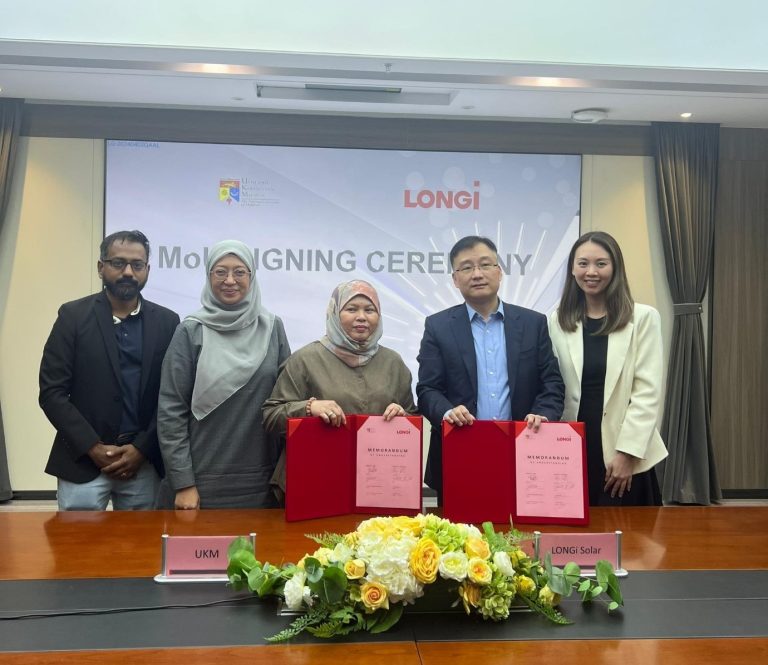
In November 2025, SERI formalised a strategic research collaboration with LONGi Solar and Pekat Teknologi. This partnership is a pivotal moment for the institute. As SERI Director Prof Dr Norasikin Ahmad Ludin noted, it is time for the university to move beyond theoretical research and apply its outcomes to create tangible benefits for society. The collaboration brings together ¼¯ÃÀÂ鶹’s cutting-edge academic research with LONGi‘s global industrial expertise.
What makes this partnership particularly significant is the concept of a “living laboratory.â€� Under this collaboration, the ¼¯ÃÀÂ鶹 campus will transform into the first facility in the region to test the real-world impact and performance of next-generation solar technologies specifically silicon-perovskite tandem panels under the distinct and challenging conditions of the tropical climate. These real-world showcases will serve as a national benchmark, demonstrating the practical outcomes of sustainable energy research for the industry and the nation. This is precisely the kind of applied research that Malaysia needs to ensure that solar technologies deployed locally are optimised for local conditions such as humidity, soiling, shading, floating systems and urban solar integration.
SERI’s role extends beyond research. The institute offers postgraduate programmes that develop skilled human capital to meet the demands of the renewable energy sector. By nurturing local talent and facilitating knowledge exchange between academia and industry, SERI is helping build the workforce that will drive Malaysia‘s energy transition.
A Vision for the Future
Back-contact PV should be viewed not simply as a new module category, but as a platform for the next phase of crystalline silicon solar. Its future lies in combining high efficiency, improved field reliability, better aesthetics, lower lifetime energy cost and compatibility with next-generation tandem structures such as perovskite/silicon. LONGi’s HPBC roadmap shows how this transition may move from laboratory records to industrial scale.
For Malaysia, the opportunity is clear. With LONGi‘s manufacturing footprint in Kuching and Serendah, and with SERI-UKM serving as a bridge between academic research, industry expertise and national policy goals, the country can position itself not only as a solar deployment market, but as a regional contributor to the next generation of PV technology. The NETR provides the policy framework. LONGi provides the technology and manufacturing base. SERI-UKM provides the research capability, the talent pipeline and the real-world testing ground.
Together, these elements create a powerful ecosystem that can accelerate Malaysia’s energy transition, create high-value jobs, and contribute to a cleaner, more sustainable future for all Malaysians.